Updated June 20, 2014:
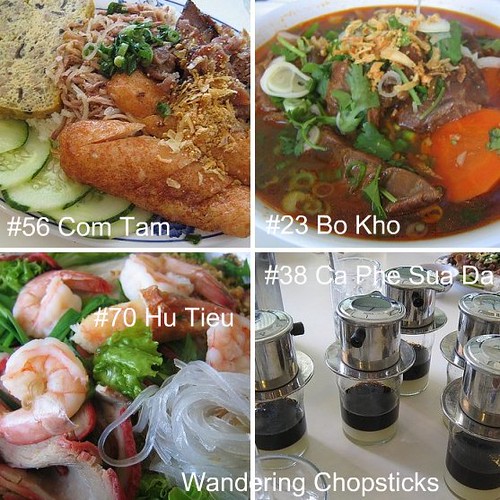 100 Vietnamese Foods to Try
Hi!
When I originally started Wandering Chopsticks in June 2006, I imagined the blog would serve up a handful of recipes and restaurant reviews. Just an index with some pictures. Rather devoid of personality actually. Sounds boring, right? But somewhere along the way, a little bit more of me crept in with each post. Then a little more. Then I started making friends, in real life and online. Then I started getting subscribers. (Who
are all you regular lurkers anyway?) Then I started getting asked the same questions over and over again. Sooooo...since I'm coming up on my 1,000th+ (!!!) post, I guess it's time to write a "proper" "About and FAQs" page. I'll keep this link at the top of the navigation bar and update this page if necessary. Drop a comment if you'd like to ask anything that I haven't covered.
And in case you missed it, my Vietnamese food biases can be found on my original "
About This Blog" post. My first year anniversary post answers "
How and Why I Started Blogging."
Questions are a compilation of actual frequently asked questions, or just some points I wanted to make about the blog. I'll try to make this as readable as possible. Apologies for the rather stilted format.
Who is Wandering Chopsticks?
I live in Southern California. I like to eat. I like to cook. I like to share both with others. I also sometimes blog about where I've been, what's growing in my garden, or what quilt I'm working on. Occasionally, I have not-so-deep thoughts on all of the above, which you can find under
Random Musings. If you're new to this blog, nose around there and you'll get a better sense of me.
Beyond that, if you're a faithful reader, you'll eventually fill in the blanks. If you're not a faithful reader, then I'm sorry, but I'm not answering personal questions from absolute strangers.
How do I navigate this site?
You can click on
Directory to see links to major categories. The top of the navigation bar includes links to the
Recipe index with (as of now anyway) more than 600 original recipes by yours truly;
Restaurant index with more than 400 reviews; and
Random Musings which are now separated by thoughts on
blogging,
family,
food, and
travel. The main directory link, however, also includes my
Copyright and Attribution Requirements,
Coupons and Discounts,
Fun Food,
Gardening,
Quilting (and Some Crocheting and Knitting Too),
Readers Cook Wandering Chopsticks' Recipes, and
15 Seconds of Fame.
On the sidebar, you'll also see my archives. Titles for the current month's posts are shown. Just click on the little arrow and previous months or years will drop down and show titles of each post too.
Or if you just feel like browsing through a subject, you can type a keyword into my searchbar or scroll down to my tag cloud and click on any subject. Hold your mouse over the categories and you can see how many posts I've written about that subject.
Also, if you haven't noticed,
my Flickr widget includes random photos from the blog. So if a particular picture strikes your fancy, you can click on it, and it should include a link back to my original post so you can get more info on the recipe or restaurant. Consider it a random snapshot of my archives. If there's no link, then I uploaded the photo but haven't gotten around to blogging about it yet.
 Bun Bo Hue (Vietnamese Hue-Style Beef Noodle Soup)
Why "Wandering Chopsticks"?
Bun Bo Hue (Vietnamese Hue-Style Beef Noodle Soup)
Why "Wandering Chopsticks"?
I originally answered this in my "
5 Things About Me" post, but here it is again.
"I chose the name Wandering Chopsticks because I was thinking of something along the lines of traveling and eating.
Wandering Chopsticks is also a translation of the Japanese word mayoi-bashi, which is frowned upon by many Asians because it is considered rude to let your chopsticks hover over the dinner table while you decide what to eat. My momma taught me to eat what's in front of me, and to never appear to choose the best morsels for myself.
Wandering Chopsticks is also the title of an episode of a 1990s Japanese series called Baian the Assassin, Vol. 3: Wandering Chopsticks/Early Summer Rain. The very hunky Ken Watanabe stars as Baian, popular acupuncturist by day, professional assassin of villains at night. Hehe, and no, I didn't know about the Watanabe connection until after I had already chosen my alter-ego."
Why are you so mysterious? How come your real name and picture aren't on here?
I'm sure
you're nice, but have you heard of stalkers and identity thieves? I'd rather not have exact details of anything easily available online.
Some people use blogging as their personal journals online. While I do share some details, I am not one of those people. Please respect that.
Why do you have "Wandering Chopsticks" watermarked on your pictures?
Unfortunately, far too many websites have repeatedly stolen entire posts, all the writing, the step-by-step photos, and the recipes and republished them on their websites. I know the watermarks don't look very nice, but not only do these websites steal and republish my entire content, they also cut off my peripheral watermarks and slap theirs on my photos. So I've had to resort to putting my watermarks in more central locations in the pictures in an attempt to subvert that from happening.
Not only are these thefts disheartening and bothersome, but Google ranks
duplicate content lower in search results, which affects my overall blog
traffic. It's a Catch-22, lower blog traffic means the blog appears
lower in search results, which in turn lowers my blog traffic even more.
I put a lot of work into developing these recipes, photographing the process, editing the photos, and writing the posts to let someone else benefit from my hard work. I'm not talking about other websites taking a photo or snippets and linking back, these websites are stealing
entire posts and pretending my content is theirs and making money off of it. This has happened fairly frequently. I hope readers can understand and deal with a slightly intrusive watermark in order for me to prevent such thefts from repeatedly happening.
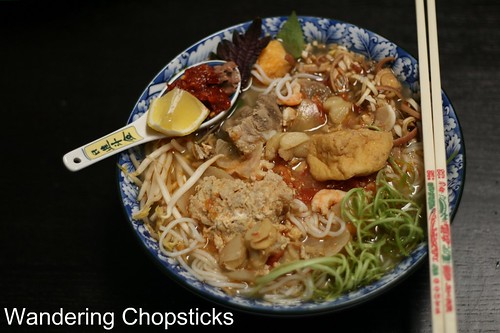 Bun Rieu Cua Tom Oc (Vietnamese Crab and Shrimp Rice Vermicelli Noodle Soup with Snails)
Why are you so obsessed with food?
Bun Rieu Cua Tom Oc (Vietnamese Crab and Shrimp Rice Vermicelli Noodle Soup with Snails)
Why are you so obsessed with food?
I've got some thoughts on this that will probably turn into a separate post at some point, which I'll link here if/when I do. On a deeper level, food connects me to my culture, my family, my history. Superficially, it's my primary means of socialization with my family and friends. Plus, I'm Asian, isn't being obsessed with food genetic? ;)
What do you hope to do with this blog?
I believe food is the most accessible way to learn about another culture. I may not be able to travel the world, but I can at least attempt to eat or cook every cuisine available to me. There's no deadline, it's a lifelong process. Through my recipes or restaurant reviews, I hope to encourage others to venture out and explore for themselves. As for the traveling and gardening stuff, I could talk about the interplay between travel/culture/cuisine or gardening/eating the foods you grow/eating local/eating organic/
composting to reduce your impact on the environment, but I won't. The connections are there if you want to think about them.
How did you learn to cook? Where do your recipes come from?
I originally answered that and my philosophy about food in "
How I Learned to Cook and My Ba Noi (Paternal Grandmother)'s Death Anniversary Dinner." Many of my Vietnamese and some of my Chinese recipes, I learned from helping my
ba noi or my mom in the kitchen. As they didn't cook from recipes, I have since incorporated my own techniques and tastebuds. So while the initial cooking instruction might have come from my
ba noi or my mom, the recipes are uniquely mine.
Sometimes I try to recreate a dish I ate somewhere, sometimes I get inspiration from other blogs, sometimes I just play around with my food. After I started the blog and explored more recipes or restaurants, I began cooking by taste. I rarely cook exact recipes. More likely, I glance at the list of ingredients and start mentally calculating what I'd like to adjust when I make it. If I used someone else's recipe entirely, rather than re-printing it here, I provide a link back to the original source. I also link back if I've adapted someone else's recipe. While I love sharing my recipes, they're written based upon
my tastebuds. So please adjust recipes to suit
your tastebuds.
If you're Vietnamese or Chinese and my recipe isn't exactly the way your momma made it, that's because I'm not your momma. So unless you're from my family, chances are you've got a different way of doing things. In some cases, you may be unfamiliar with some of the dishes I grew up with. In other cases, what you call something, in my region we call it something else. Just because you've always eaten a particular dish in a certain way doesn't mean that's the only way to do so. Please be respectful of regional diversity even within one ethnic cuisine.
Mainly, I cook for me, and for family and friends based upon what ingredients I have on hand or in my pantry. Substitutions exist. Because frankly, unless you're paying me, I'm not going to spend a lot of money for one ingredient if I'm not going to use it for any other dishes.
Recipes are written in the order I would do each step. I often tweak my recipes, adjusting measurements, clarifying steps, or updating with better photos. Many times, I just go ahead and make changes to the original post. Sometimes, I'll post a short note. If you wish the most current version of a recipe, then please check the original post again for any adjustments. My recipes are sorted alphabetically,
by category and
by cuisine. I also have a page with more than 100 of my
Vietnamese recipes, sorted by category. If you're using my exact recipe and wish to blog about it, I really, really would prefer that you simply link back to my original post. If you're adapting my recipe, please be courteous and give me credit. I talk more about this below.
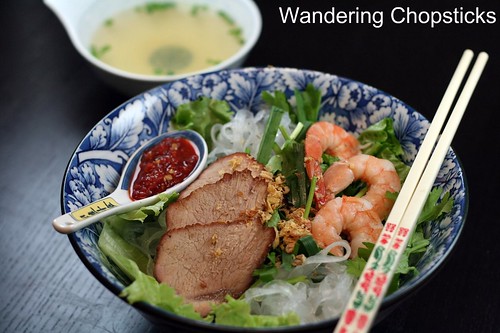 Hu Tieu Saigon (Vietnamese Clear Noodle Barbecued Pork and Shrimp Soup)
What are your restaurant recommendations?
Hu Tieu Saigon (Vietnamese Clear Noodle Barbecued Pork and Shrimp Soup)
What are your restaurant recommendations?
Restaurants are sorted alphabetically,
by city,
by county and
by cuisine. My recommended restaurants are located on my sidebar. In most cases, you can figure out what particular dishes I liked from each restaurant or how much I liked the restaurant based upon my post. I don't have an overall favorite restaurant since I go to different ones for different dishes. If you're searching for a particular dish, then please utilize the searchbar. You can then look through the various reviews and reach your own conclusion about which restaurants you would like to try.
Also, with an estimated 650 Chinese restaurants in the San Gabriel Valley, and 650 Vietnamese restaurants in Little Saigon, please do not ask me to suggest a "Chinese" or a "Vietnamese" restaurant in Southern California.
Can I give you a restaurant recommendation?
Sure. I always like getting tips, but can't guarantee I'll try it. Keep in mind, though, that if you're a complete stranger, giving me just a restaurant name doesn't do much. Providing details about what dishes you liked and why would be much more likely to encourage me to try an unknown place.
What is your restaurant review policy? Who pays?
I don't consider what I write "proper" restaurant reviews per se. They're snapshots of what I ate, sometimes with whom, sometimes a compilation of multiple visits. In short, my experience. Yours may be different. I pay for all my meals. "I," meaning me, my family, or my friends.
Free meals paid for by someone else or given by the restaurant will be stated as such.
Will you review my restaurant or product?
Maybe. If it's something I'm interested in. Contact me at wanderingchopsticks [at] gmail [dot] com and we can make arrangements. Just keep in mind that I make no guarantees that I will like what you give me. If I don't think it's relevant, I make no promises that I will even write about said product. I will only provide my honest opinion.
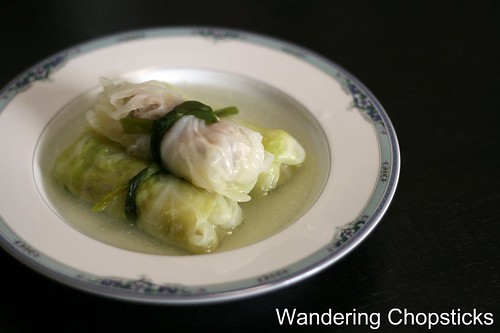 Canh Bap Cai Nhoi Thit (Vietnamese Stuffed Cabbage Soup)
When do you post? How come the posts sometimes come in batches?
Canh Bap Cai Nhoi Thit (Vietnamese Stuffed Cabbage Soup)
When do you post? How come the posts sometimes come in batches?
I try to blog regularly but am not always able to do so. I like to plan out a post a day. Many times the posts have a vague connection to each other or build upon a previous one. But then something comes up, which necessitates a newer dated entry, so I don't get around to writing what I originally intended until later. But the post is still dated for when I originally intended to publish it. Or I'll publish several posts at once. Which is simply my long way of telling you that sometimes just looking at the post at the top of the page may not necessarily be the most recently written entry. Most people don't care, but if you really don't want to miss an entry, just scroll down the main page. I keep the three most recent entries on the opening page. Why do I do this? I'm quirky like that. It's an organizational thing, which only makes sense to me.
When do you reply to comments? What's your comment policy?
I try to reply to all comments when I put up a new post. I get an email from Blogger whenever someone leaves a comment. So if you left a question on an older post, just check back in that thread and your reply will be there. You can also check the box to get updated replies by email.
I used to have a pretty open comment policy. After repeated Spam or rude commenters, I have taken off the anonymous option. If you're not a blogger but would like to leave a comment, you can create an account on Blogger or Gmail. I reserve the write to delete any Spam or rude comments. For more clarification on what caused this change, you can read my post "
Musings on Tea Tree, Thank You Cards, and Meyer Lemons."
Why do you reply back on comments instead of email?
If you want a reply by email then email me. Otherwise, sometimes questions asked in comments may answer someone else's questions as well. Also, I view comments as an ongoing conversation with many of my regular readers.
Do you answer all emails?
Yes, unless you're rude or too nosy. I especially love complimentary emails. :) If you catch me online when I'm updating my blog, or if it's a quick question, I usually reply pretty quickly. Otherwise, it may take a few days or a week, or if I'm terribly busy, even a month. If you didn't get a reply, then send again. Your email may have never reached me or ended up in my Spam folder. Also, check your Spam folder, my reply to you might have gotten junked.
 Goi Ga Bap Cai (Vietnamese Chicken Cabbage Salad)
Will you answer my questions about... ? Do you have a recipe for... ? Where can I get... ? Why does this... ? Which one do you like more... ?
Goi Ga Bap Cai (Vietnamese Chicken Cabbage Salad)
Will you answer my questions about... ? Do you have a recipe for... ? Where can I get... ? Why does this... ? Which one do you like more... ?
Depends. Are you sure I haven't answered it already? I spent a lot, and I do mean a lot, of time compiling my archive directory. It's quite extensive, so please utilize the
directory or my searchbar. If it's something that can be found online, then please use Google or whichever search engine of your choice. If it's very clear that you didn't even bother to look through my archives or use my searchbar, I won't be very helpful.
If, after you've done all that, and still want to ask me a question, please make it as specific as possible. I've said it before, with 650 Vietnamese restaurants in Little Saigon, 650 Chinese restaurants in the San Gabriel Valley, and 650 Korean restaurants in Koreatown, DO NOT ask me for a "Vietnamese" or a "Chinese" or a "Korean" restaurant recommendation. The restaurant index is sorted by city, county, and cuisine. Please utilize it. Searching for a specific dish? Use the searchbar. However, if you have a very specific question, and want my opinion, then I might be able to help you.
Be very specific. What area are you looking? Type of cuisine? Price range? How many people? Etc. Otherwise, use my searchbar or look through my archives. I've been repeatedly getting questions from people that are easily answered if they had only bothered to do a simple search. If I sound annoyed, that's because I am. I'm trying to be nice about it, but if you're too lazy to click on my restaurant index or type in a search, why should I bother helping you? And if you do email me, tell me what you have looked at, so I don't waste time directing you to information you've already seen. Please be considerate of my time as well.
Do you really expect a "thank you" after you reply to my email?
Yes. An email after I've answered your question with a quick "thank you" is all I ask. If you don't have the courtesy of thanking me, I will ignore any future emails.
For more thoughts on this subject, you can read "
Musings on Tea Tree, Thank You Cards, and Meyer Lemons" but to summarize:
"But after almost two years of blogging, answering a lot of emails, I'm tired of people who never learned manners. No. No. This doesn't apply to my blogging friends and regular readers. I'm talking about the random people who delurk to ask long, detailed questions. After I reply, they don't even have the courtesy to write a quick thank you. Now, I'm not saying you have to be Dave and thank me on your wedding day (Although, I surely did appreciate it Dave!).
You should always say thanks when you ask someone to do something for you. And emailing me to ask a question, which I take time out of my day to respond to, sometimes in very lengthy replies, constitutes as asking someone to do something for you. After I reply, all I ask is for a quick thank you. This has happened often enough that I'm seriously bothered by it. Off the top of my head, I can think of at least half a dozen other bloggers who have mentioned this same problem."
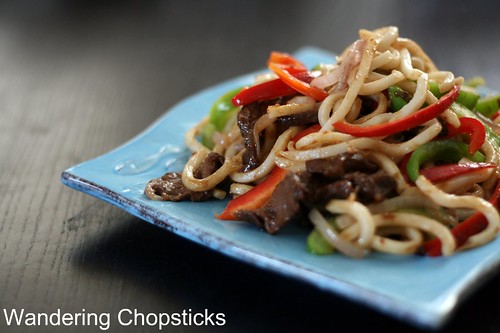 Yaki Udon (Japanese Stir-Fried Udon Noodles)
I love your blog, how can I support you?
Yaki Udon (Japanese Stir-Fried Udon Noodles)
I love your blog, how can I support you?
Aww, shucks. Thanks for the compliment. If you tried any of the restaurants or my recipes, I'd love to get your feedback. Please leave a comment in the original post since others may find it useful as well.
You can also bookmark and share favorite posts so that others can discover it too. It's easy. Just use the handy little bookmark icon at the end of each post.
As for monetary support, your visits pay my advertisers, who in turn pay me. If you use my Amazon link to search for and then purchase products, I get a whopping 4% commission. I try not to make the ads too intrusive, but honestly, the money does help defray some of the costs of groceries and dining out. It's really a drop in the bucket though in terms of the amount of time I spend grocery shopping, cooking, photographing, sorting through photos, watermarking photos, uploading photos, and then writing my posts.
Can I be on your blog?
Glad you asked. I've started a series called
Readers Cook WC's Recipes. Please check it out if you're interested.
Can I come over for dinner?
I get that if you've been reading my blog for a while, you think you know me. However, I don't know you. If you're not a blogger, and you've never,
ever commented on my blog or sent me an email, so as an
absolutely complete stranger, your first contact with me is to ask if you and your husband can come over for dinner for cooking lessons, this is a
guaranteed way to
freak me out. No, I am not making this up. Yes, the person was completely serious. I should clarify that I was discussing dinner plans with online friends on
another website. Maybe the person thought it was an open invitation, when it clearly was not. As a result, I was so rattled, I didn't blog for weeks. So please,
do not freak me out and do not stalk me elsewhere online. So no, if I've never met you, if you aren't a blogging friend or acquaintance, if you aren't a reader who emails me regularly, if you aren't even a regular commenter, you
cannot come over for dinner.
Can I link to you? Will you link to me?
Yes, feel free to add a link to me if you like my blog. However, my sidebar is reserved for blogs that I actually read. Please don't take it personally.
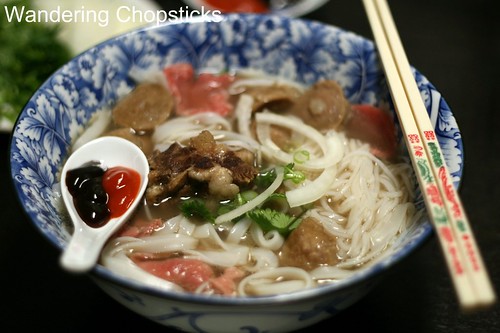 Crock Pot Pho Bo (Vietnamese Beef Noodle Soup)
How do you pronounce pho?
Pho
Crock Pot Pho Bo (Vietnamese Beef Noodle Soup)
How do you pronounce pho?
Pho is your friend, not your foe. Please do not pronounce it as such. The ? accent in Vietnamese sounds like a question, so say
pho? as if it were a question and you'd be closest to its proper pronunciation.
How do you spell banh mi?
NH always. Nh. Nh. Nh. Is that clear? I cringe every time I see it misspelled.
When are you gonna post a recipe for com ga Hai Nam (Hainanese chicken rice)?
Not sure. Family recipe and all that. Plus, my aunties and uncles make it often enough to satisfy my occasional craving. And yes, the family recipe knocks the socks off
Savoy Kitchen's version, or any other restaurant version actually. And no, asking me repeatedly won't get you the recipe, it only annoys me further.
Why is my Vietnamese coffee dripping so quickly? I tried screwing the filter tighter?
Sigh. Please read my recipe for
Ca Phe Sua Da again. In detail. I've bolded the key points.
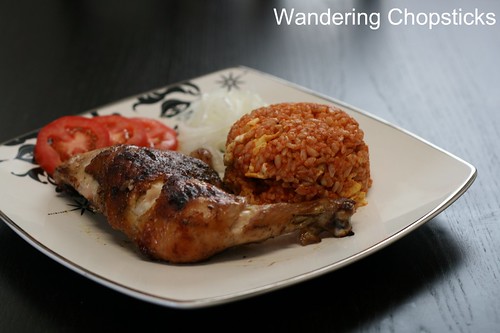 Ga Ro Ti (Vietnamese Roasted Chicken)
May I have your permission to use your photo or recipe on my blog or elsewhere online? Can I use your pictures for a presentation for school?
Ga Ro Ti (Vietnamese Roasted Chicken)
May I have your permission to use your photo or recipe on my blog or elsewhere online? Can I use your pictures for a presentation for school?
For educational, non-commercial purposes, I might say yes. I'd appreciate sending me an email request first.
For online usage, again, please read my recent post "
Musings on Tea Tree, Thank You Cards, and Meyer Lemons" for my feelings on the matter. To repeat myself,
"I will say it again. I really, really do not like other people using my photos. If you must, then you need to attribute it to Wandering Chopsticks and link back to me. (But seriously, if you're already making my recipe, why aren't you photographing it and posting that photo? Too much work you say? Then think of the amount of work I put in to cook, photograph, organize photos, watermark, upload, and then blog about it.) If you're using my recipe in its entirety, then I prefer that you link back to my recipe post instead of posting it on your blog. If you're adapting my recipe, then have the courtesy to say it was adapted from Wandering Chopsticks and link back to me. If you have any ads on your blog at all, then republishing my photos or recipes violates the non-commercial terms of my copyright notice."
And so you can't say you didn't know, my full copyright notice is below.
*****
Copyright © 2006-2014 by Wandering Chopsticks
I spend a lot more time than I should eating out, cooking, photographing, and writing about it for this blog. I love sharing my food finds and creations with all of you. However, that does not give you the right to steal my images or words. All photos and text on Wandering Chopsticks are protected under the
1998 United States Digital Millennium Copyright Act. You do NOT have permission to reprint my photos or text without my permission. You may republish
parts of my text or photos provided you adhere to the following copyright and attribution requirements below.
Also, I spent a great deal of time gathering information, thinking up, and writing my copyright and attribution requirements. This is not a form. I did not cut and paste this post from somewhere else. It saddens me that I have to say this, but if you found this post useful, please write your own copyright and attribution requirements in your own words. Do not cut and paste mine.
*****
Copyright © 2006-2014 by Wandering Chopsticks. All rights reserved. Do not copy my content without my permission or without attribution. It makes me angry. And when I get angry, I tell people about
content thieves.
Attribution Requirements
You do NOT have permission to republish any of my posts or recipes in their entirety. What you may republish are excerpts of my text or recipes, or you may republish a photo to illustrate a post, provided that you adhere to the following requirements. That means you may reprint parts of my text or recipes, or a photo, but NOT BOTH.
For photographs:
If you reprint a photograph from Wandering Chopsticks, you must state, "
Photo by Wandering Chopsticks." This must appear either directly above or below the photograph, and must be in the same size font as the rest of your text. You must also provide a working clickable link back to the post in which the photograph appeared. You also are not allowed to cut out my watermark.
For recipes:
If you are using my exact recipe, you do NOT have permission to reprint it on your blog. You may include the list of ingredients, but then you must
write the directions in your own words and provide a working clickable link back to that post on Wandering Chopsticks. Example: "
Recipe from Wandering Chopsticks"
If your recipe is an adaptation, it should say "
Recipe adapted from or inspired by Wandering Chopsticks," you must also provide a working clickable link back to the original recipe on Wandering Chopsticks.
Example:
Fried Rice with Chinese Sausage recipe adapted from Wandering Chopsticks
On linking back: All links back must be working clickable links directly to
the exact blog post or the Wandering Chopsticks main page.
Example:
Wandering Chopsticks not just typing out http://wanderingchopsticks.blogspot.com
For text:
If you quote any part of Wandering Chopsticks, you need to place quotes or highlight the copied text in such a way as to make it clear that the quoted portion is NOT yours. You must also include the title of the post you're quoting, state "
By or From Wandering Chopsticks," and provide a working clickable link back to the original post you're citing.
Example: From "
Coq au Vin (French Chicken with Wine): the French Meal I Wished I Had,"by Wandering Chopsticks,
"He sends me an email in French a month later telling me how he'll always treasure the memories of our walk in Paris. He closes with a phrase that my fluent French-speaking friend insists isn't to be taken literally. But it's oh so lovely, that I choose to take the meaning as such.
"
Je t'embrasse tendrement partout et surtout avec délicatesse,"which according to worldlingo.com means "I tenderly kiss you everywhere and especially with delicacy.""
Non-Commercial
You may not use this work for commercial purposes or advertising. Do not use any words or photographs from this blog in any way in which you make money.
That means that if you are a business or have any ads on your website, you may NOT use any of my photos or text. Please link back to me and to the exact post instead.
No Derivative Works
You may not alter, transform, or build upon this work. You may re-size but you may not crop or edit my photos. You may not remove my watermark. If you choose to republish my photos, you must host them on your own server.
If you're unclear about any of this, please email me first at
wanderingchopsticks [at]
gmail [dot]
com .
*****
1 year ago today, dainty little
Cucumber Sandwiches.